
Practical Procedure
Hand Hygiene
Empress Healthcare Inc. — Field Reference for All Patient-Care Staff
Applies to: RN, LVN, CHHA, PT/PTA, OT/OTA, MSW, and any other staff who provide direct patient care or enter a patient’s home | Use: Orientation, annual refresher, and field reference
Purpose
Why hand hygiene matters
In the Agency’s own words, hand hygiene is done “to reduce the transfer of microbes to patients and to prevent the growth of microorganisms on the nails, hands and forearms” (P&P §5.7 POLICY). It is the single most effective, lowest-cost defense against healthcare-associated infection, and it is how the Agency demonstrates compliance with the Condition of Participation for infection prevention and control at 42 CFR 484.70(a)–(c).
Structured observation of hand hygiene has not previously been performed at Empress. Under the CY2026 Hand Hygiene Goal, every clinician is now observed at least once a quarter, and for most current staff that will be their first formal observation. Use this page to get the technique right before it happens.
Infection Control Program hand hygiene compliance target. P&P §5.1 item 4.3
An honest starting point, set by the Annual Hand Hygiene Goal — CY2026.
The ramp from the baseline floor back up to the program goal.
What this page covers
What you should be able to do
- State the Agency’s nine required hand hygiene indications and recognize each in real home-visit situations. P&P §5.7 PROCEDURE ¶1
- Perform the soap-and-water handwashing technique to full standard, including the current 20-second scrub.
- Perform the alcohol-based hand rub (ABHR) technique to full standard, rubbing until hands are completely dry (about 20 seconds).
- Identify when soap and water is required instead of ABHR — most importantly visibly soiled hands and C. difficile / spore-forming organisms.
- Apply hand hygiene to the nursing bag technique, including the ninth indication: before re-entering the bag.
- Recognize the most commonly missed hand hygiene errors and self-correct them.
When
The nine required indications
The Agency’s own procedure (P&P §5.7 ¶1) names nine indications. This is the operative list — it is what Form 5.7B.7 observes against and what the Annual Hand Hygiene Goal measures.
Indications 1–9
- 1
Before and after direct patient care
Before physically approaching the patient for the visit; immediately after physical contact ends.
- 2
Before and after each procedure
Wound care, injections, catheter care, specimen collection, medication administration.
- 3
After using the bathroom
Use the patient’s bathroom facilities per Agency infection-control practice, and dry with a disposable, single-use towel.
- 4
After blowing or wiping the nose
Same as in any setting.
- 5
Before and after eating
Relevant on long visit days. Also a patient and caregiver education topic.P&P §9.22
- 6
Before and after collecting a specimen
Lab draws, wound cultures, and urine or stool specimen collection in the home.
- 7
When hands are soiled
A hard trigger for soap and water over ABHR, regardless of convenience — see “When ABHR is not enough” below.CDC Category IA — soap and water required
- 8
After any contact with contaminated materials
Soiled linens, dressings, trash, and the patient’s environment and surfaces.
- 9
Before re-entering the nursing bag or the patient’s clean supplies
The bag travels between the clean exterior and the patient-zone interior of the home. Re-entering it with unclean hands contaminates every supply inside it — for every patient afterward.P&P §5.7 ¶1.9 · no general acute-care equivalent
NoteThis is the home health–specific indication, and it is the one that connects this page to step 9 of the Nursing Bag Technique.
See alsoFour home-health timing points sit inside indications 1 and 9 and are reinforced throughout P&P Chapter 5:
- On entering the home — before setting down the bag, touching Agency equipment, or beginning clinical contact.
- On leaving the home — after final patient contact, before re-entering the vehicle.
- Between patients on the same day — a full before/after cycle resets for each new patient.
- Before donning and after removing gloves, every time — gloves are not a substitute for hand hygiene.
Procedure
Two techniques, step by step
Each step cites its source — an Empress P&P §, the adopted CDC guideline table in §5.7 ¶7, or current CDC hand hygiene guidance, which the Agency follows (§5.7 ¶7).
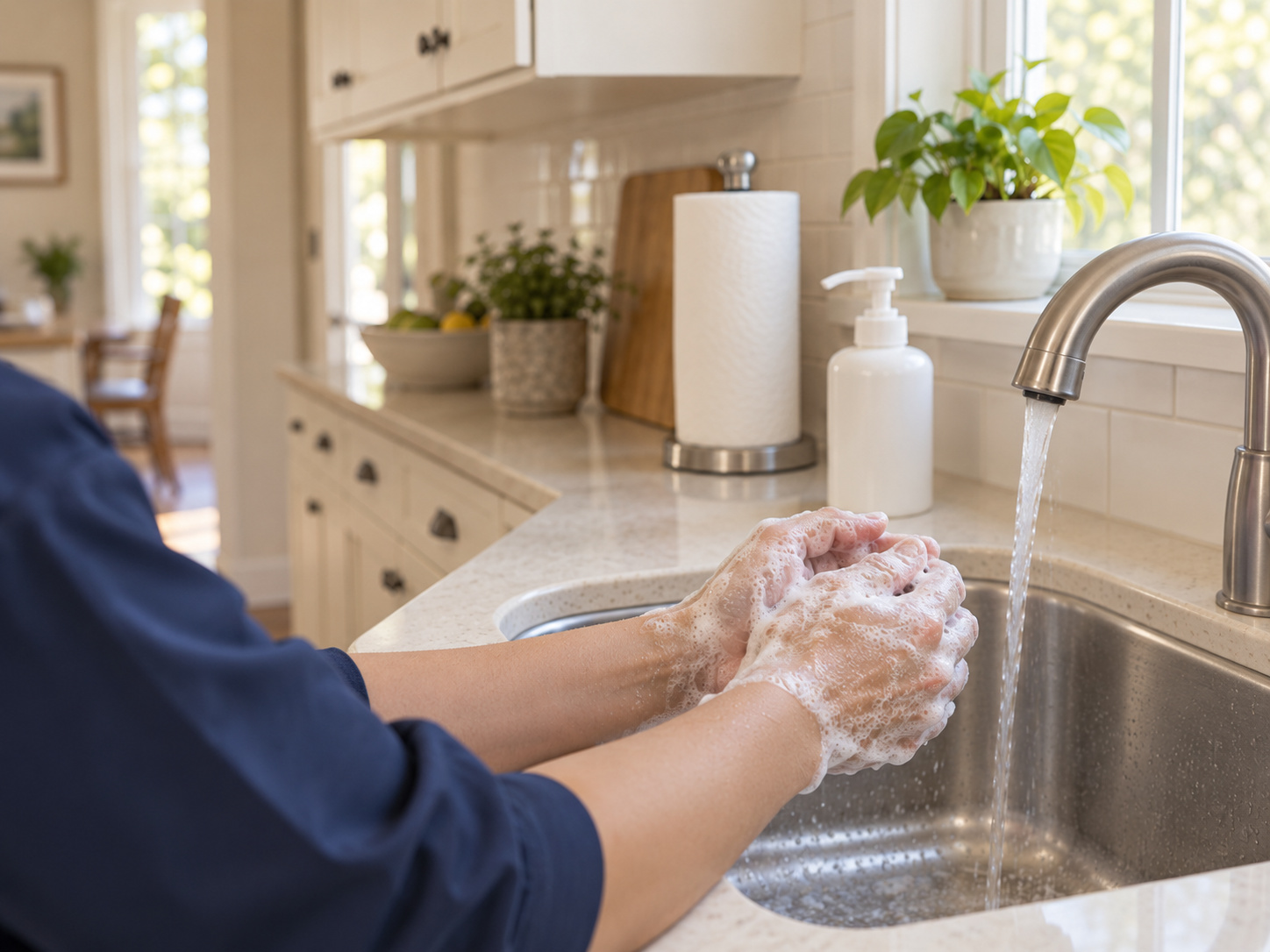
Handwashing with Soap and Water
- 1
Turn on the water
Set it to a comfortable warm temperature. Avoid very hot water — it increases the risk of dermatitis, which matters for a technique performed many times a day.P&P §5.7 ¶4, ¶7
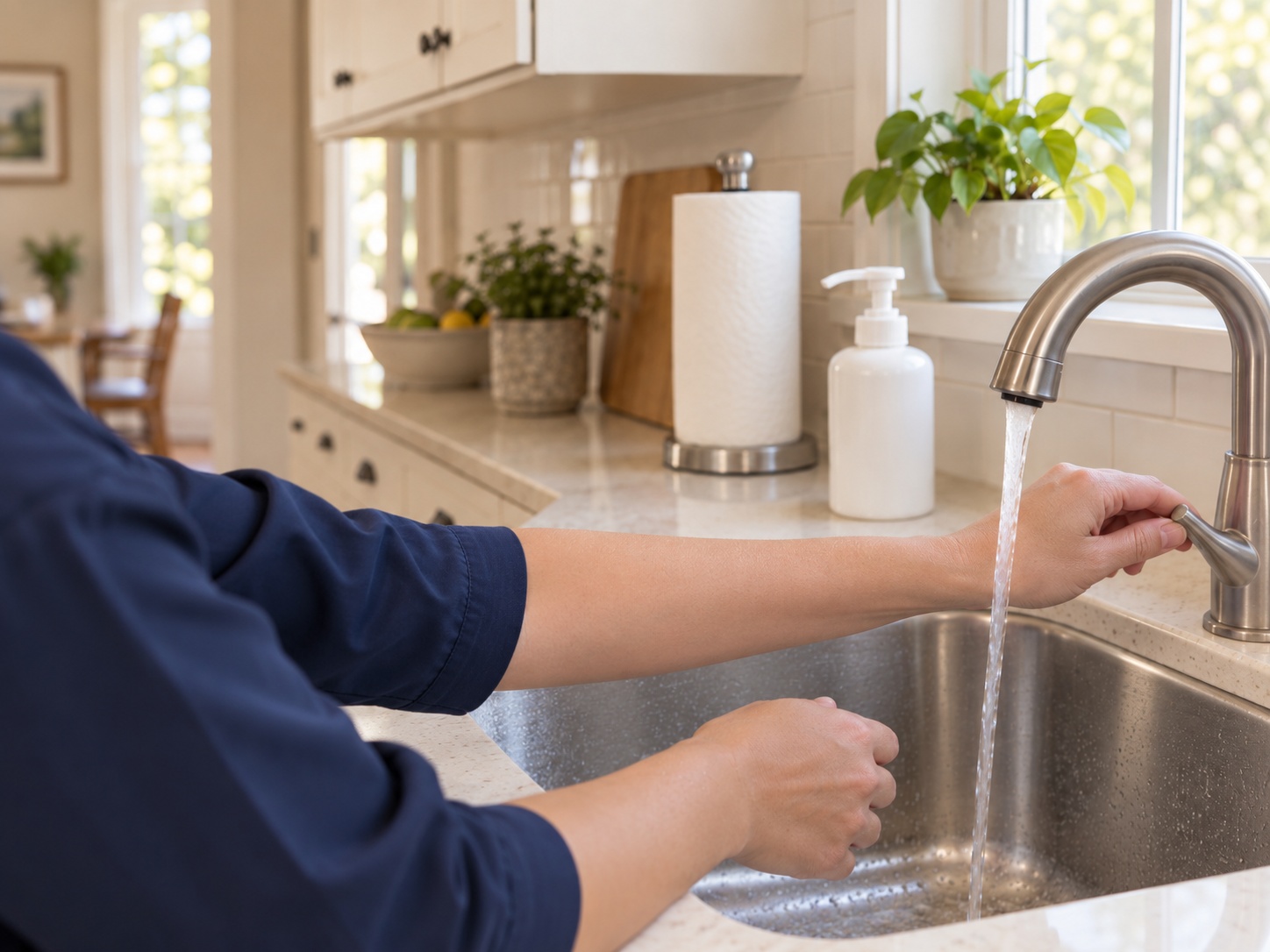
Warm, not hot. - 2
Wet hands completely
Under running water.P&P §5.7 ¶4
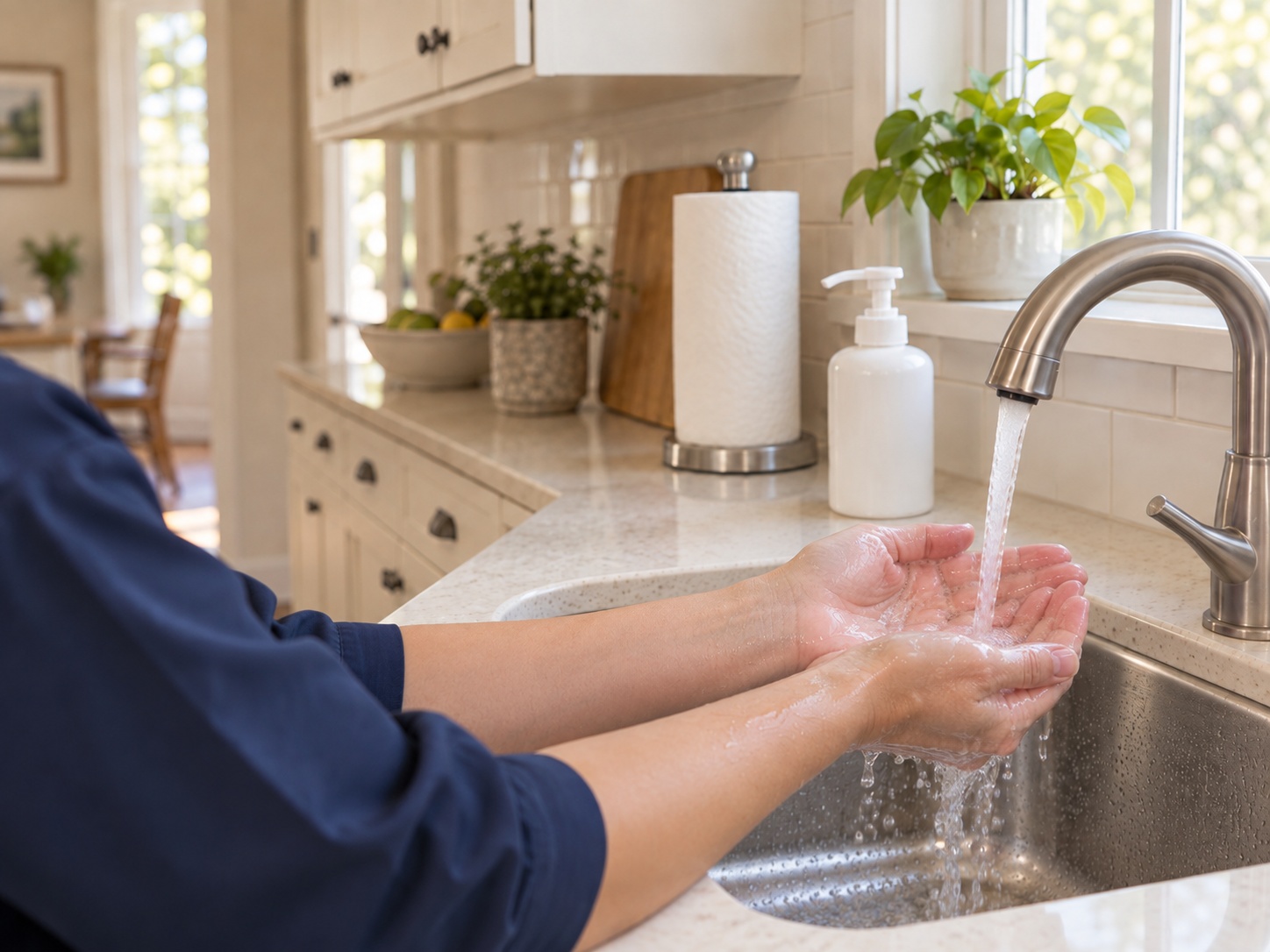
Wet all over before any soap. - 3
Apply liquid antimicrobial soap and lather with friction
Cover every surface, in this order:
- Palms, rubbing palm to palm
- Backs of both hands
- Between all fingers, interlaced
- Backs of fingers to opposing palms (knuckles)
- Around and under the fingernails of both hands — named in the Agency’s own procedure, and the surface most often skipped
- Both thumbs, rotational grip
- Wrists, if visibly or potentially contaminated
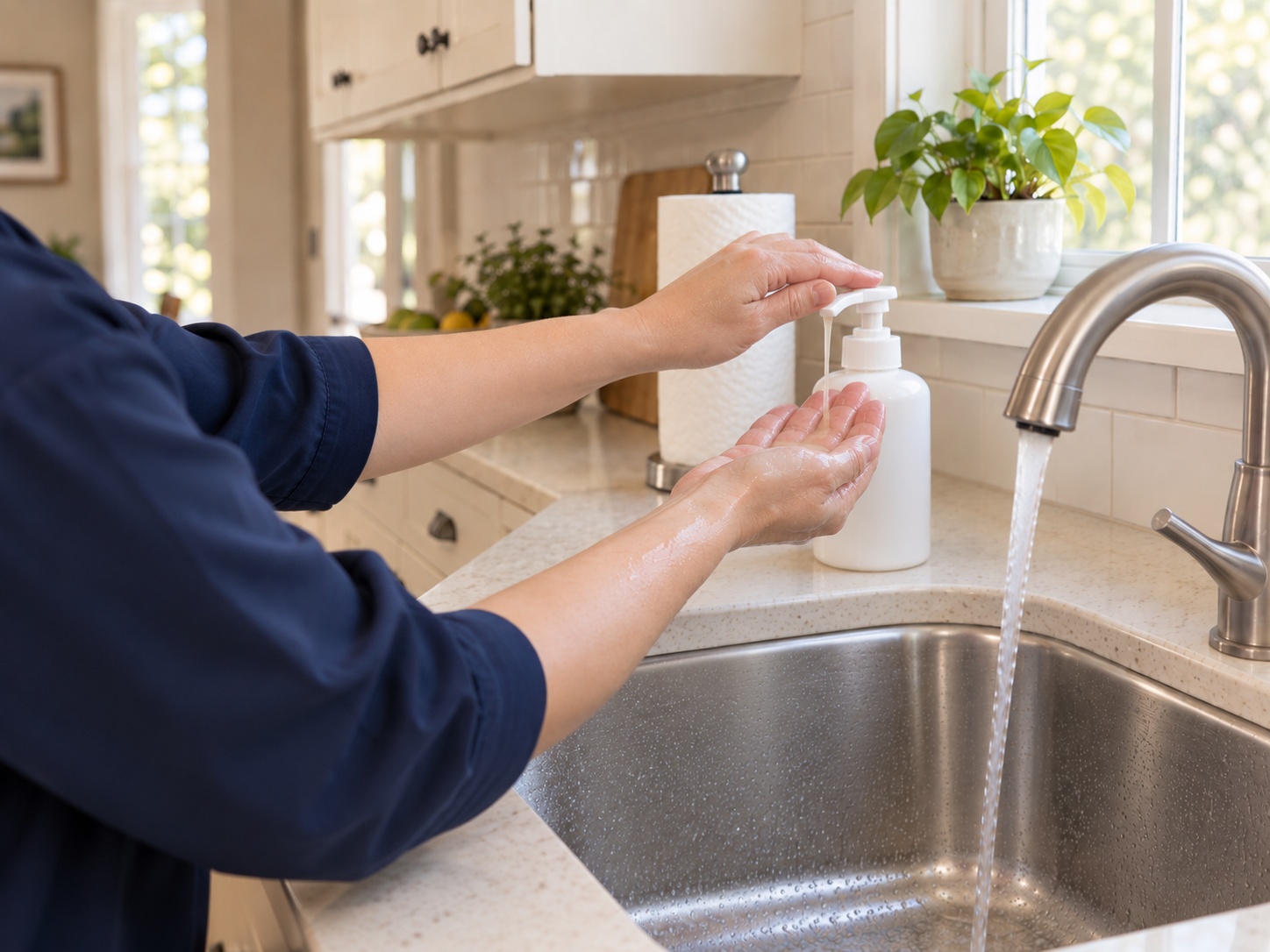
Liquid soap, straight into the palm. - 4
Scrub for at least 20 seconds
Lather and scrub every surface for a full 20 seconds before rinsing. This is the Agency’s standard and matches current CDC guidance — it is the duration you will be observed and timed against.P&P §5.7 ¶4; CDC, “Life is Better with Clean Hands”
TipHum “Happy Birthday” start to finish, twice. Count it — don’t judge 20 seconds by feel.
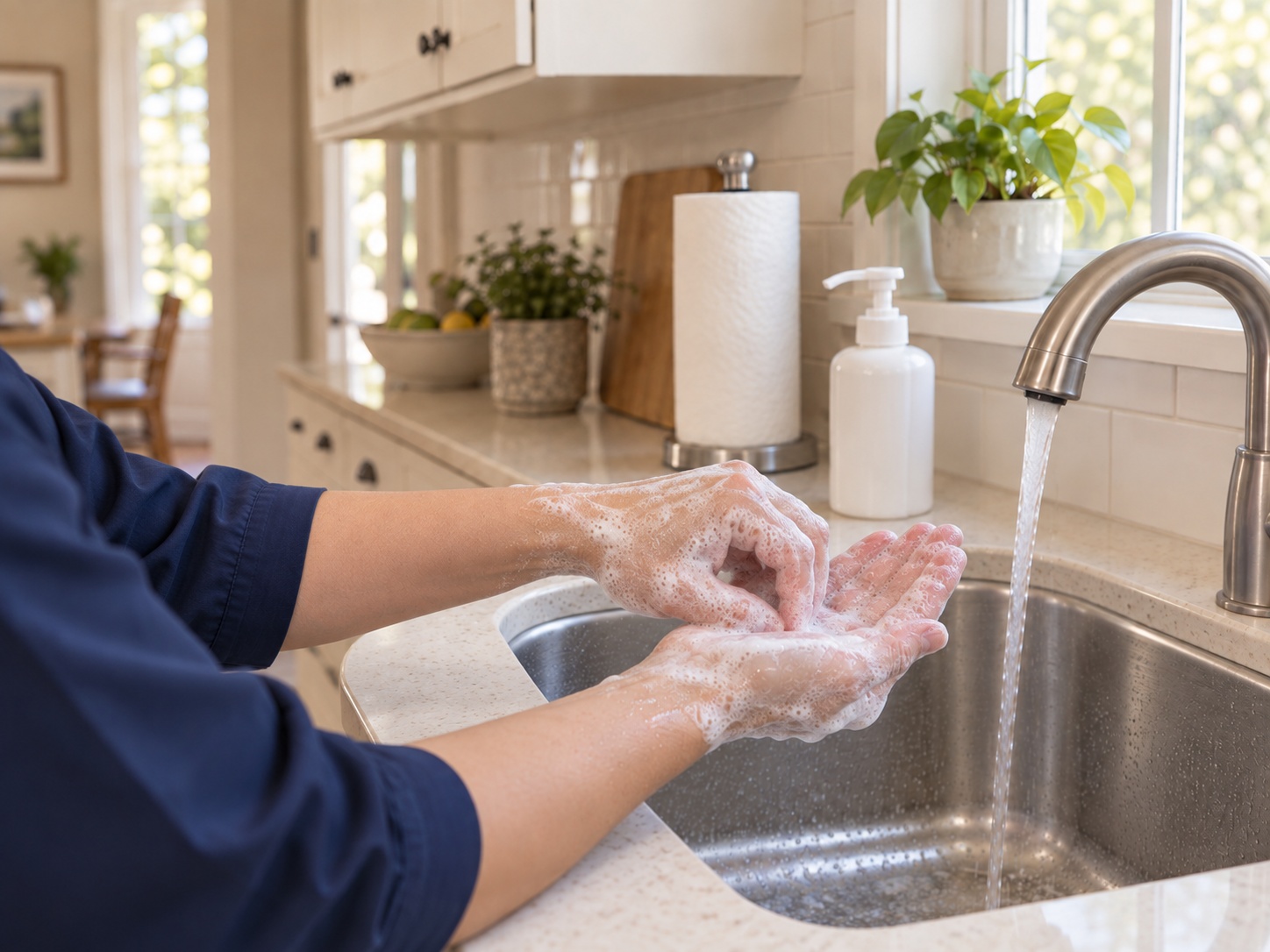
Count it: twenty seconds, fingertips and nails included. - 5
Rinse hands well
Under clean, running water, fingers pointed down so water runs off the fingertips.P&P §5.7 ¶4
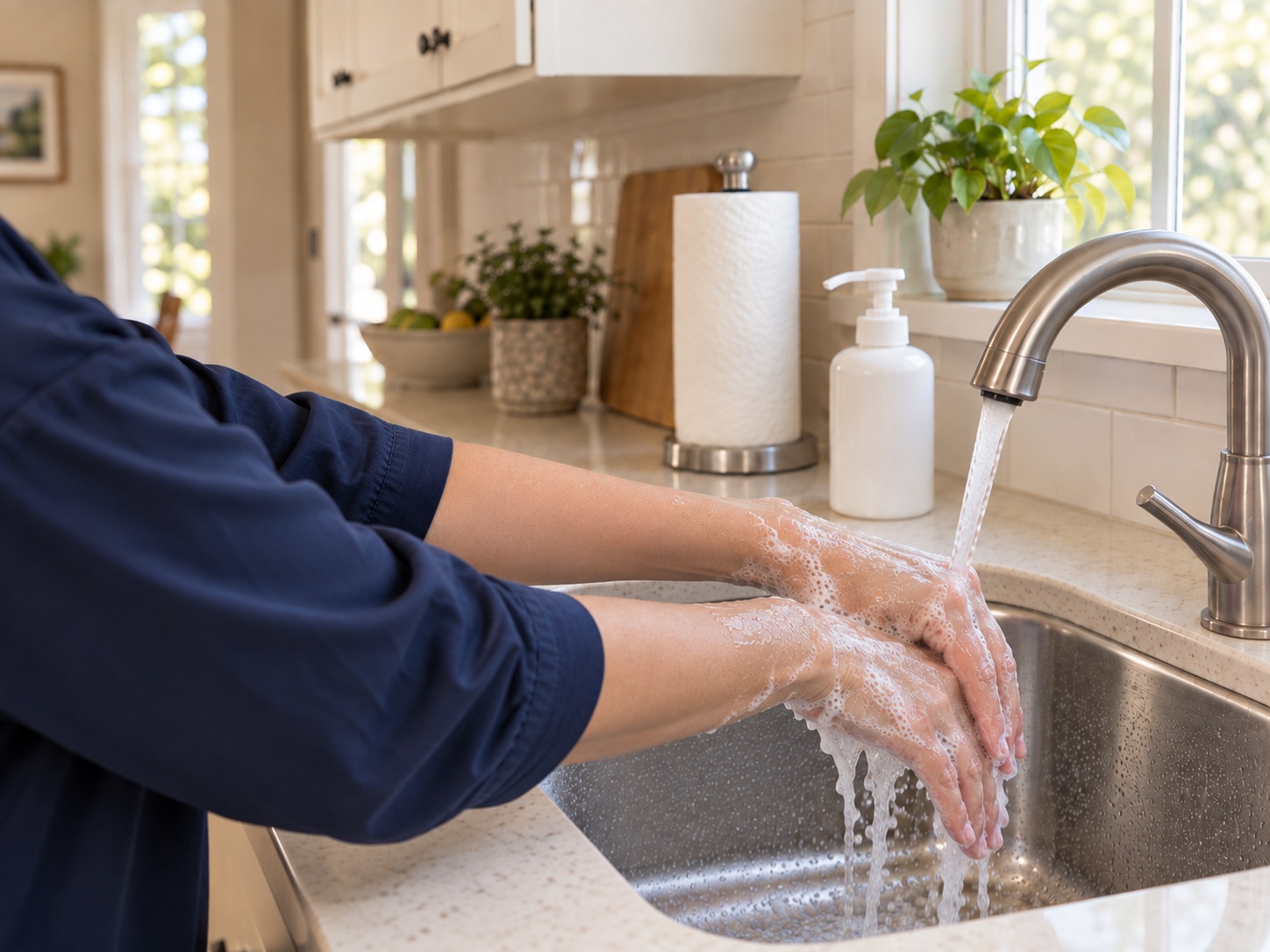
Fingertips down, so water runs off them. - 6
Dry thoroughly with a single-use paper towel
Never a shared or multi-use cloth towel.P&P §5.7 ¶4
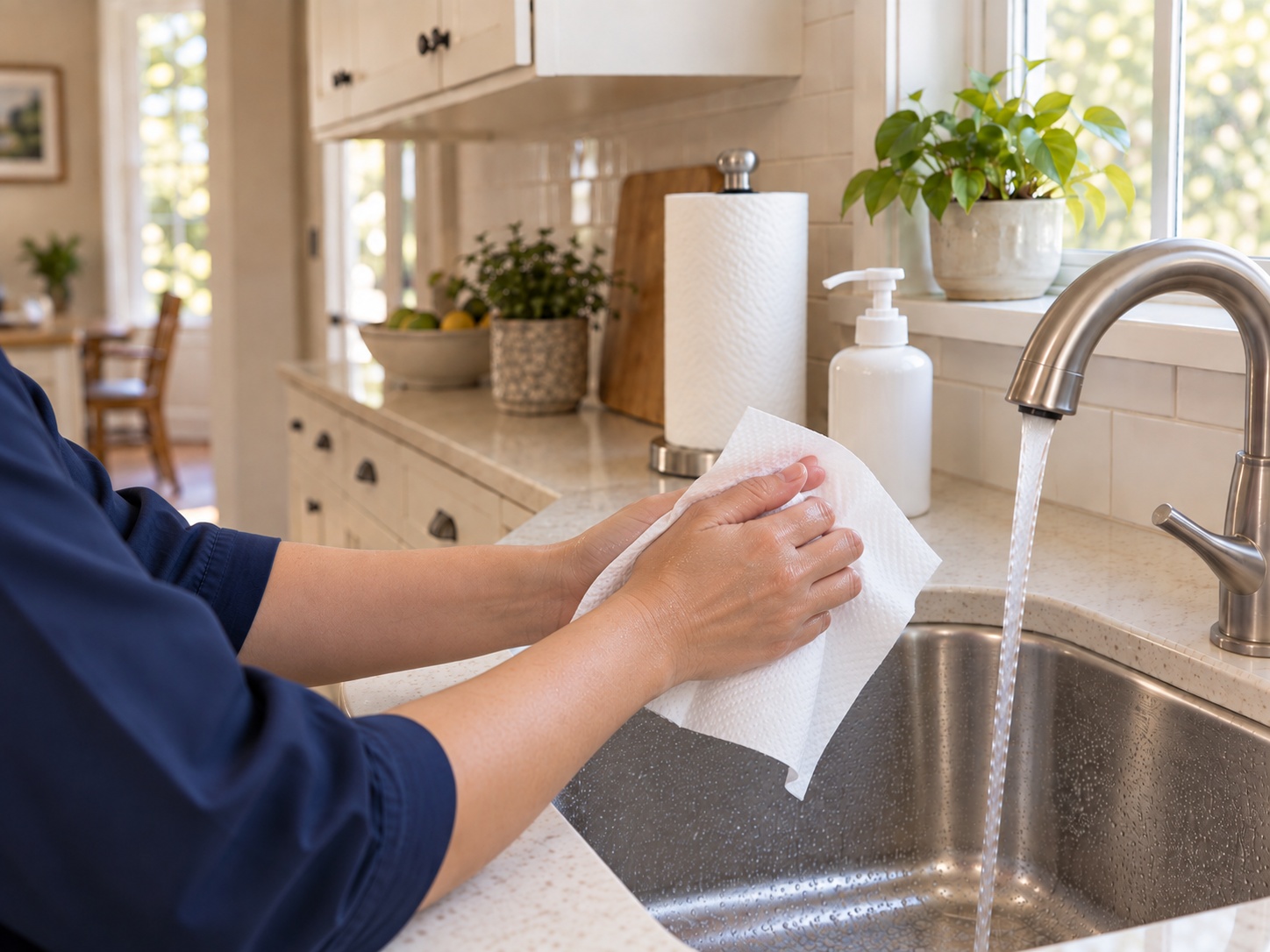
Paper, single use — never a cloth towel. - 7
Turn off the faucet using the towel
Not your bare, just-washed hands — this prevents recontamination from the faucet handle.P&P §5.7 ¶4
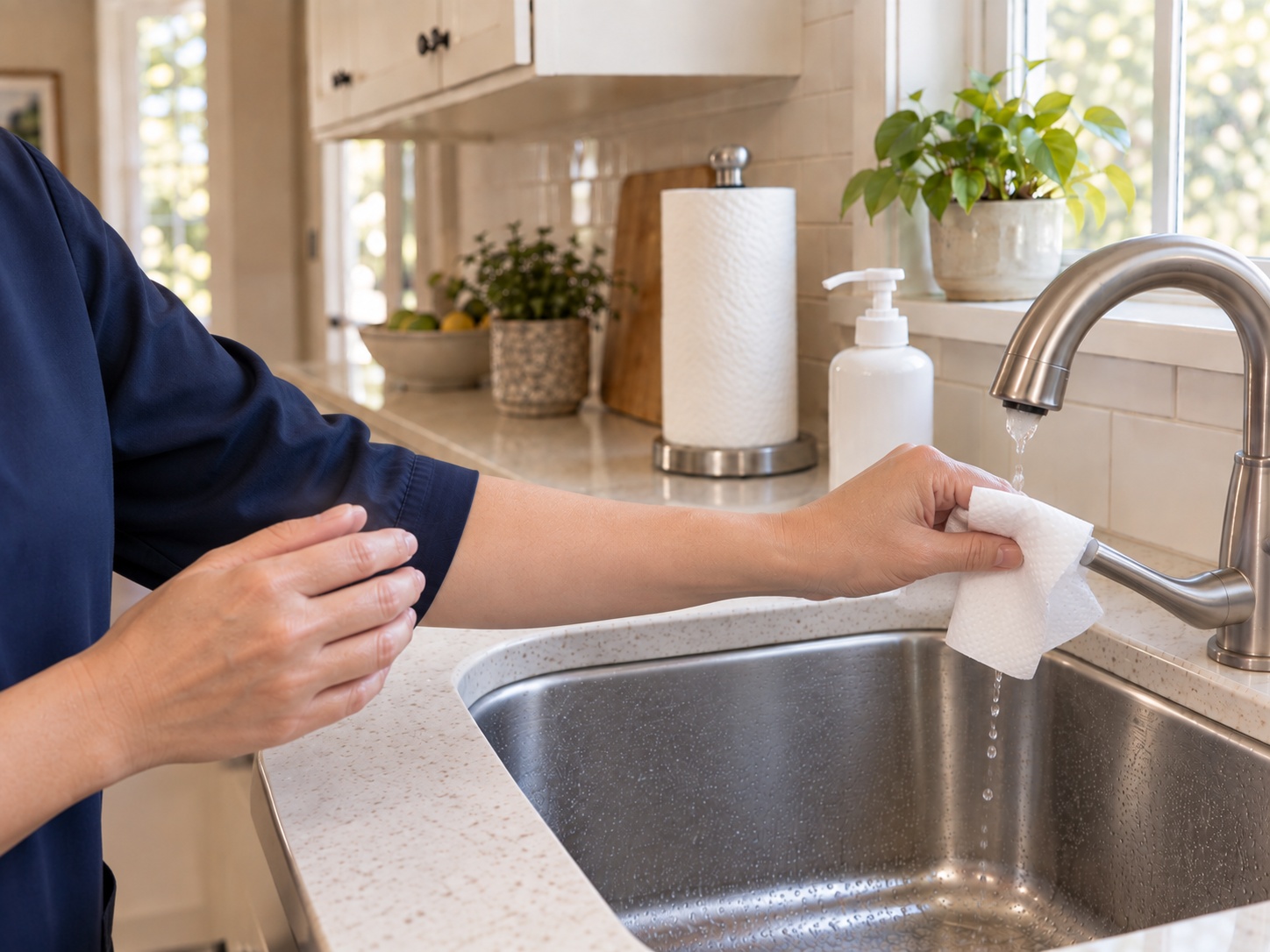
The towel touches the handle, not your hand. - 8
Discard the paper towel
In a disposable bag or waste can.P&P §5.7 ¶4
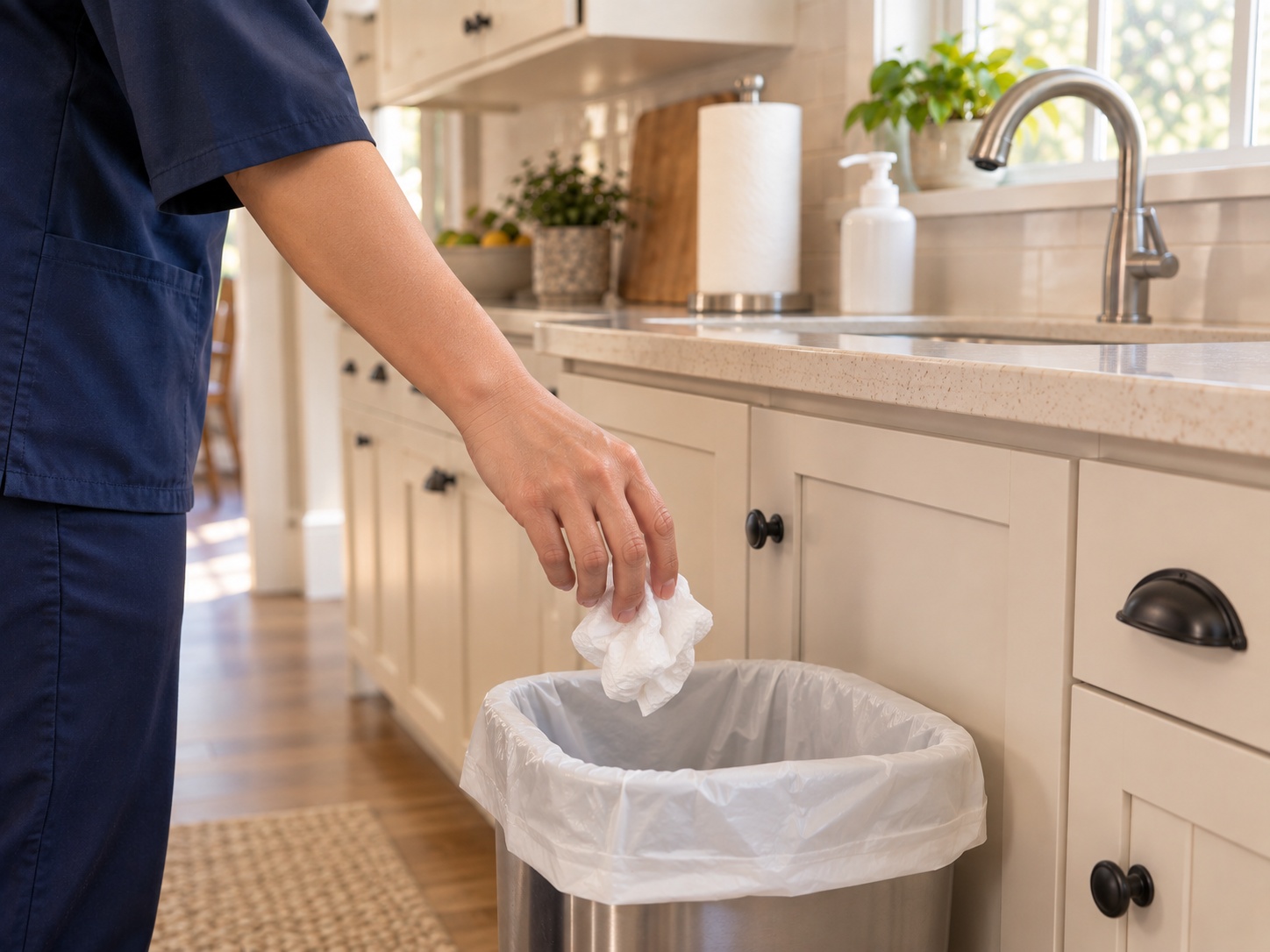
Straight into a lined bin.
Realistic total time, wet to dry: 40–60 seconds at a normal, unhurried pace with a 20-second scrub. That is the expectation — not the 20-second scrub alone.
Alcohol-Based Hand Rub (ABHR)
ABHR is the Agency’s preferred hand hygiene method when hands are not visibly soiled (P&P §5.7 ¶3; §5.7 ¶7 section I.B, adopted CDC guideline). This is the “accepted standard of practice” the infection-control Condition of Participation requires (42 CFR 484.70(a), G682).
- 1
Apply product to the palm of one hand
Use the amount the manufacturer recommends — the dispenser’s stated dose per pump.P&P §5.7 ¶3; CDC, Hand Hygiene Guidance
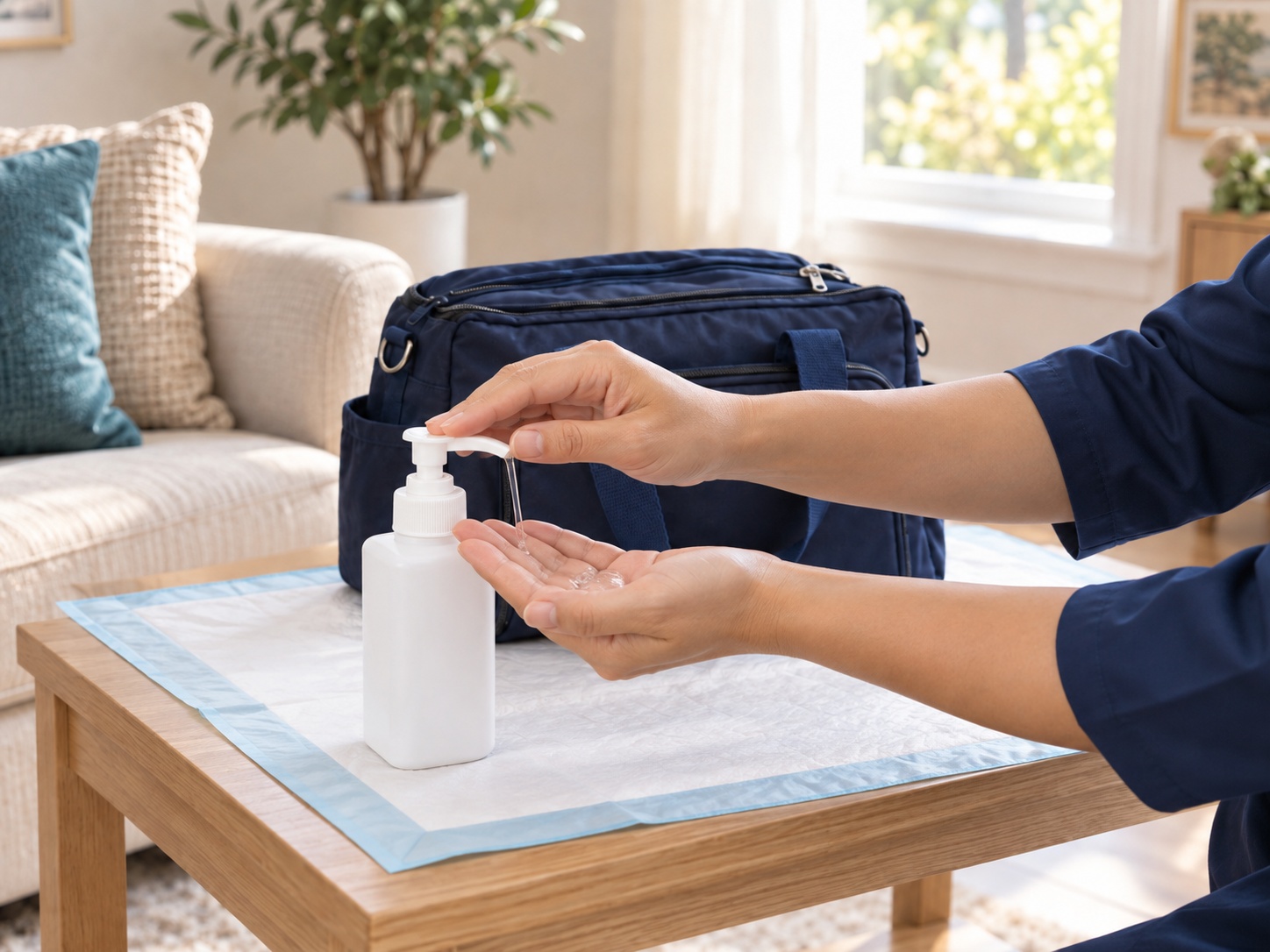
The manufacturer’s dose, into one palm. - 2
Rub your hands together, covering all surfaces
Palms, backs of the hands, between the fingers, and around and under the nails.P&P §5.7 ¶3; CDC, Hand Hygiene Guidance
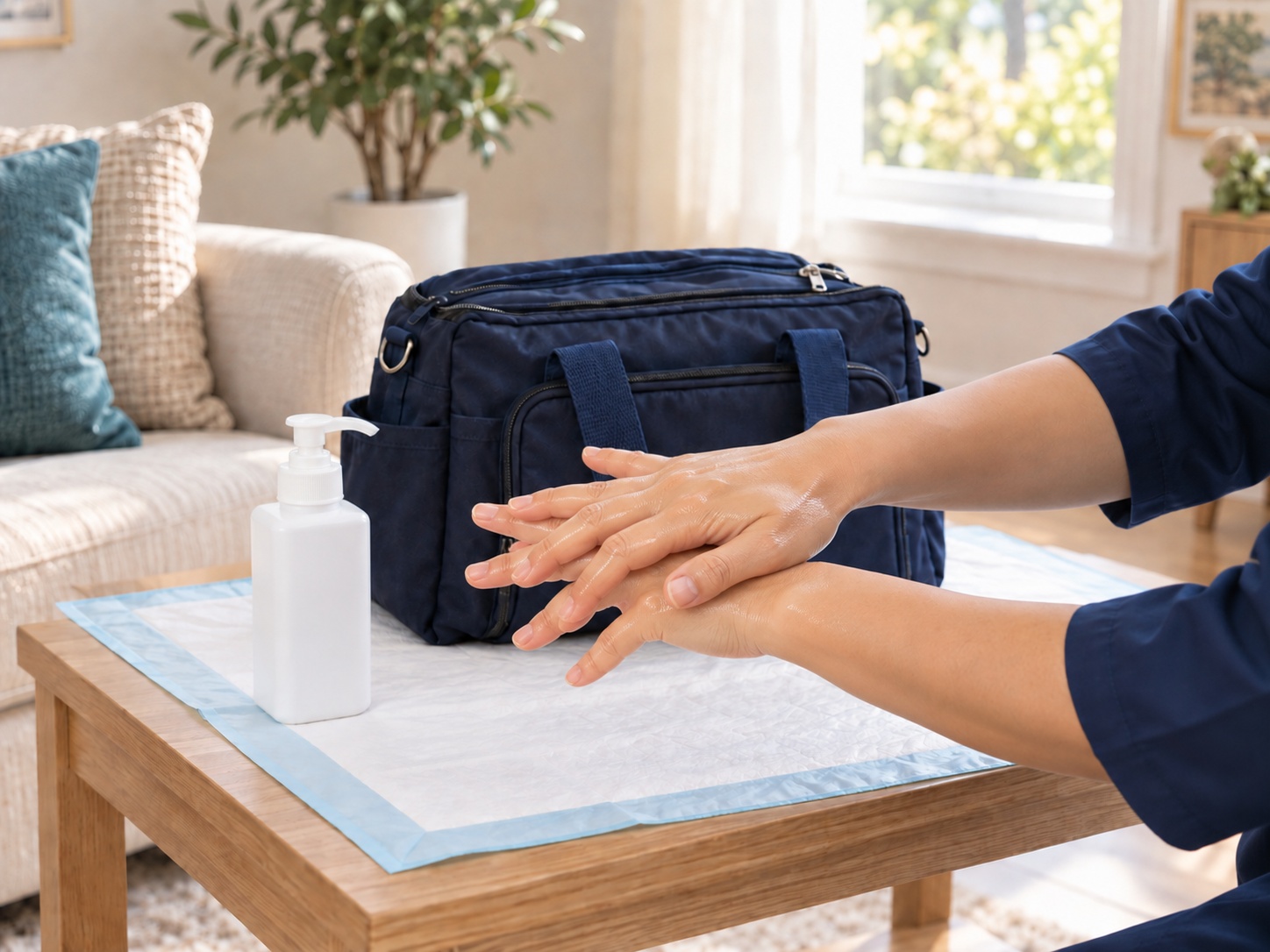
Backs of the hands and between the fingers count too. - 3
Give extra attention to the spots most often missed
Thumbs, fingertips, and between the fingers.CDC, Hand Hygiene Guidance
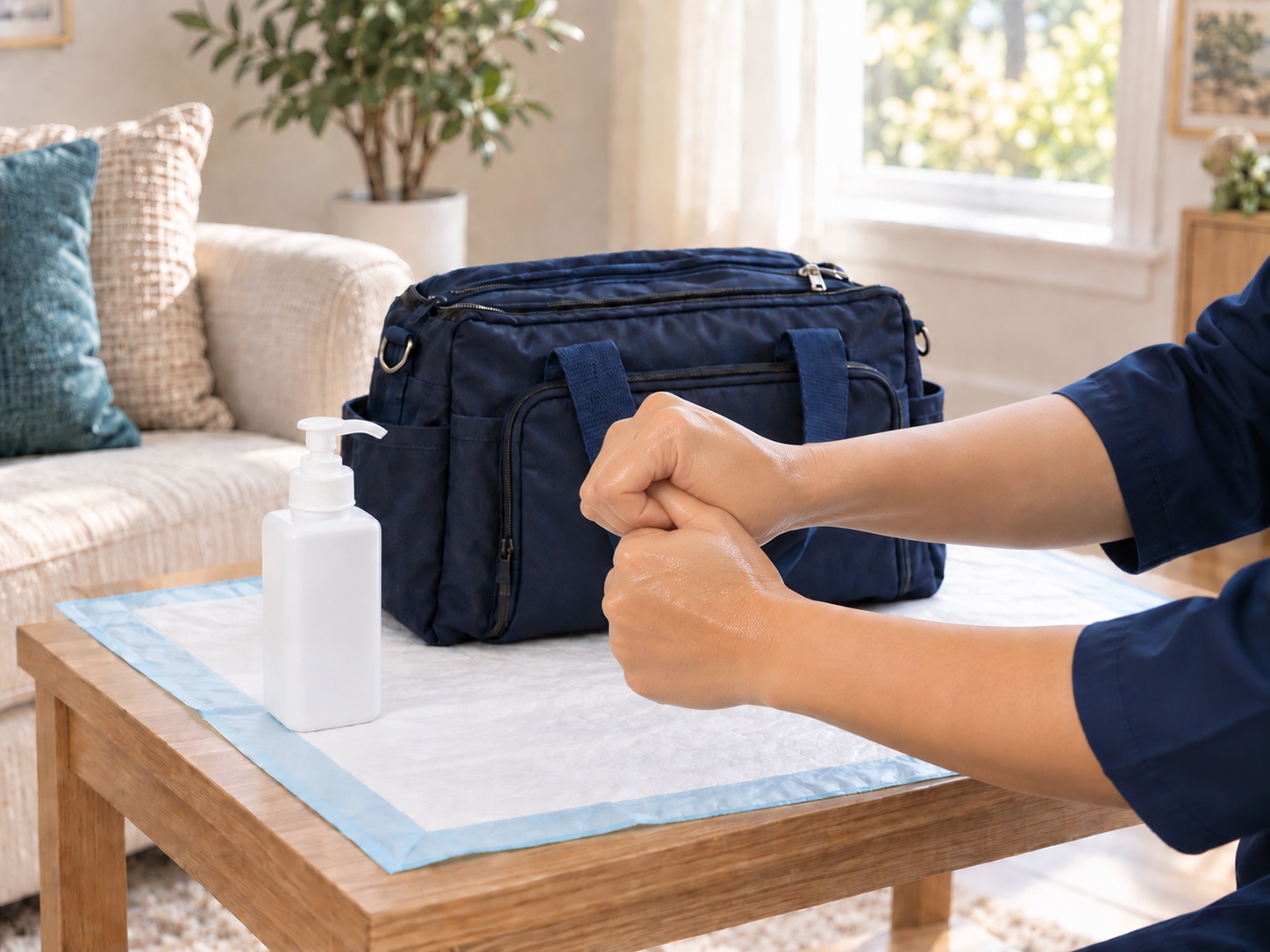
Thumbs and fingertips are the most-missed spots. - 4
Keep rubbing until your hands are completely dry — about 20 seconds
Once dry, you are done for that indication. There is no rinse or towel step.P&P §5.7 ¶3; CDC, Hand Hygiene Guidance
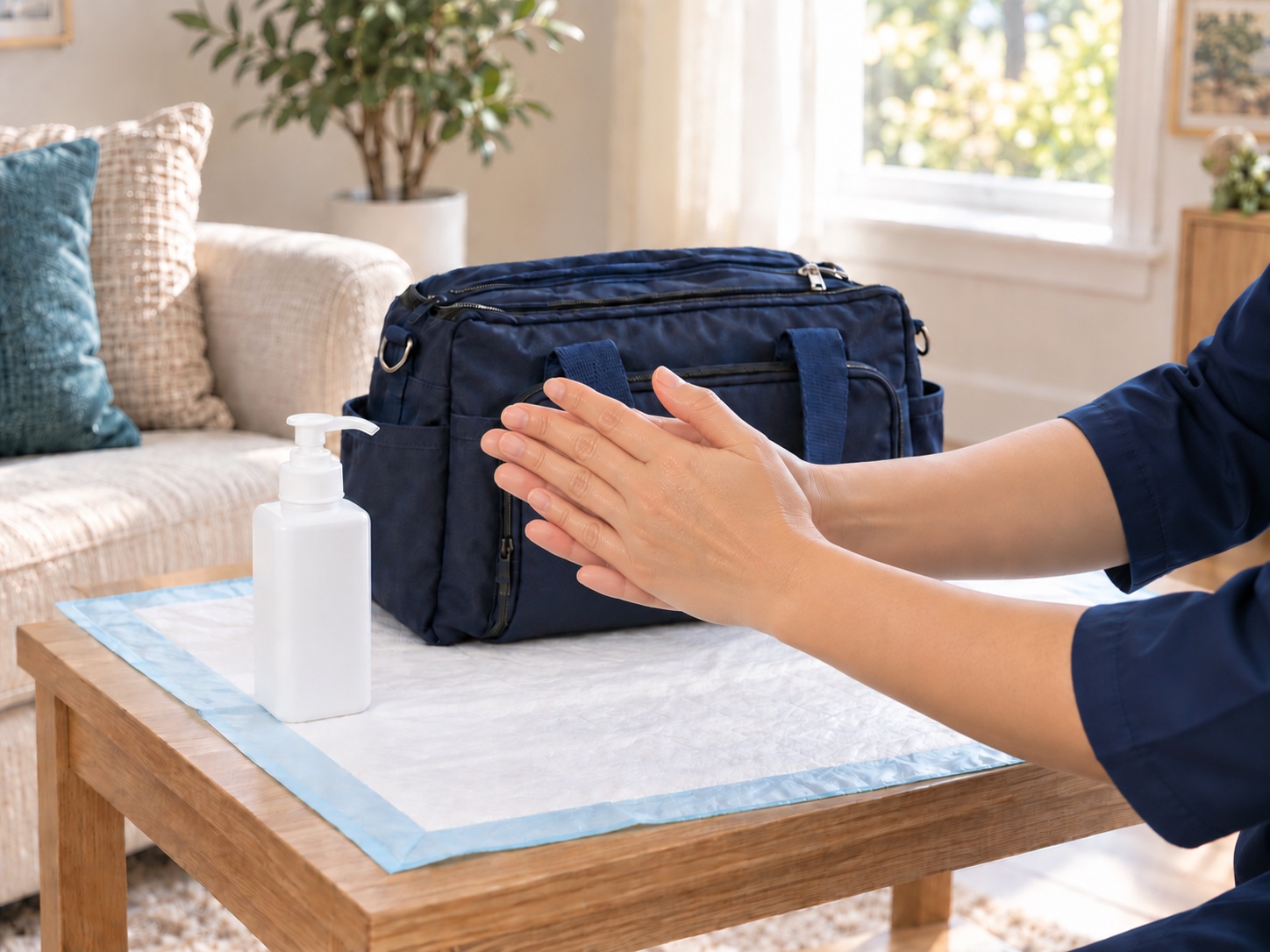
Rub until dry — then you’re done.
When ABHR Is Not Enough
WarningAlcohol does not kill spores. After removing gloves following contact with a patient with known or suspected C. difficile — or any stool contact, or during a C. diff outbreak — use soap and water, not ABHR. This is the single most important exception to remember: it runs against the everyday rule, and you will have to make the call in real time, in the patient’s home.
- A
Visibly soiled hands
Dirt, blood, or body fluids visible on the hands. Friction and rinsing physically remove the contaminant in a way ABHR does not.P&P §5.7 ¶1.7; ¶7 §§I.A, I.C
- B
C. difficile and other spore-forming organisms
Soap and water, every time — see the warning above.P&P §5.7 ¶7 §§I.A, I.C; CDC/APIC guidance on C. difficile
- C
Norovirus exposure
Taught the same way as C. diff: alcohol does not reliably inactivate it at typical ABHR concentrations.CDC/APIC guidance
- D
No ABHR at the point of care
Soap and water is the fallback. Missing supplies are the Agency’s to fix the same day — not the clinician’s to work around.
In the home
Hand hygiene through the bag technique
Hand hygiene is woven through every stage of the Nursing Bag Technique. These are the points in a visit where it is required.
| Situation | Hand hygiene required | Source |
|---|---|---|
| Entering the patient’s home | Before touching the bag, equipment, or beginning clinical contact | §5.7 ¶1.1 |
| Before donning gloves | Yes — gloves are not a substitute for hand hygiene | CDC table IV.A |
| After removing gloves | Yes, always | §5.7 ¶7 §I.B; ¶1.1 |
| Before wound care or any invasive/aseptic procedure | Yes | §5.7 ¶1.2 |
| After wound care, before touching anything else | Yes | §5.7 ¶1.1 / 1.8 |
| Before and after medication administration | Yes | §5.7 ¶1.2 |
| Before re-entering the nursing bag or clean supplies — every time | Yes — the ninth indication; not discretionary | §5.7 ¶1.9 |
| After touching a contaminated surface (linens, trash, environment) | Yes | §5.7 ¶1.8 |
| Between two patients on the same visit day | A full before/after cycle for each patient | §5.7 ¶1.1 |
| Before and after specimen collection | Yes | §5.7 ¶1.6 |
| Before leaving the home / entering the vehicle | The final hand hygiene of the visit | §5.7 ¶1.1 |
Most common lapseRe-entering the bag while still wearing gloves that touched the patient. Remove gloves, perform hand hygiene, and re-glove before opening the clean compartments.
Common errors
Where technique slips — and how to self-correct
- 1
Too short
The most commonly documented hand hygiene failure nationally — and one a simple “did it happen, yes or no” observation does not catch on its own.
Self-correctCount the full 20 seconds for washing, or keep rubbing alcohol until your hands are completely dry — every time.
- 2
Missed surfaces
Most often skipped: under and around the fingernails, between the fingers, the thumbs, and the backs of the hands and knuckles.
Self-correctGive these spots deliberate attention every time — don’t just rub your hands together generically.
- 3
Nails, jewelry, and polish
Natural nails ¼ inch or shorter from the fingertip (¶1). No artificial nails for patient-care staff — including overlays, tips, bondings, extensions, tapes, inlays, wraps, and acrylics (¶2). No nail jewelry, a flat Agency prohibition (¶3). Polish, if worn, must be a neutral color and not chipped (¶4).P&P §5.18 ¶¶1–4
Self-correctCheck your nails, jewelry, and polish before each shift — not only when you are reminded during an observation.
- 4
Skin breakdown and dermatitis
Frequent handwashing is a known cause of contact dermatitis, and sore hands lead staff to avoid hand hygiene.
Self-correctUse warm, not hot, water. Choose ABHR when hands are not visibly soiled — it is gentler on skin. Use Agency-provided moisturizer between episodes. Report cracking or breakdown to your supervisor rather than quietly cleaning your hands less.
P&P §5.7 ¶7 §§II.C, III.C.1, V.A–V.B; P&P §5.18
Important Principles
- Gloves are not a substitute for hand hygiene — clean your hands before putting gloves on and after taking them off, every time.P&P §5.7 ¶7 §I.B; CDC table IV.A
- Clean your hands before re-entering the nursing bag or the patient’s clean supplies — every time, never with used gloves on.P&P §5.7 PROCEDURE ¶1.9
- Soap and water — not alcohol rub — for visibly soiled hands and after C. difficile or other spore-forming organism contact.P&P §5.7 ¶1.7; ¶7 §§I.A, I.C
- Scrub for at least 20 seconds when washing; rub alcohol until completely dry, about 20 seconds.P&P §5.7 ¶¶3–4; CDC
- Fingernails ¼ inch or shorter; no artificial nails or nail jewelry; polish, if worn, neutral and unchipped.P&P §5.18
- Report skin breakdown to your supervisor — never reduce hand hygiene to avoid discomfort.P&P §5.7 ¶7
Sources
Empress Healthcare Inc. P&P Ch. 5 (Infection Prevention and Control): §5.1 item 4.3 (Infection Control Program goal), §5.7 (Hand Hygiene Policy and Compliance Program, incl. the adopted CDC guideline table and Forms 5.7A.6 / 5.7B.7), §5.18 (Fingernails/Artificial Nails). Ch. 9: §9.22 (Patient/Family Education). Annual Hand Hygiene Goal — CY2026. 42 CFR 484.70(a)–(c) (Condition of Participation: Infection Prevention and Control). CDC (2002). Guideline for Hand Hygiene in Health-Care Settings, MMWR (Boyce & Pittet). CDC, “Life is Better with Clean Hands” (current handwashing guidance). CDC, “Hand Hygiene Guidance” for healthcare providers (cdc.gov/clean-hands, last reviewed February 27, 2024).
This page is built from the Agency’s Hand Hygiene In-Service Training module, so the page and the training packet cannot drift apart. Where this page and the Policy & Procedure manual disagree, the manual governs — tell the Director of Clinical Services rather than working around it.